
Compliance Compass
- Home
- Compliance Compass
PCI Certification & Compliance Support
Navigate complex payment security requirements with specialized support across PCI DSS, PCI PTS, PCI P2PE, PCI Software Security Framework, PCI 3DS and PCI MPoC.
EazyPay Tech helps banks, fintech companies, payment service providers, OEMs, terminal manufacturers, software providers and digital payment businesses assess security requirements, identify compliance gaps, prepare products and environments for testing, and move through applicable PCI assessment and validation processes.
From payment devices and SoftPOS platforms to payment applications, cardholder data environments and connected payment infrastructure, we help simplify the journey toward stronger payment security and compliance.
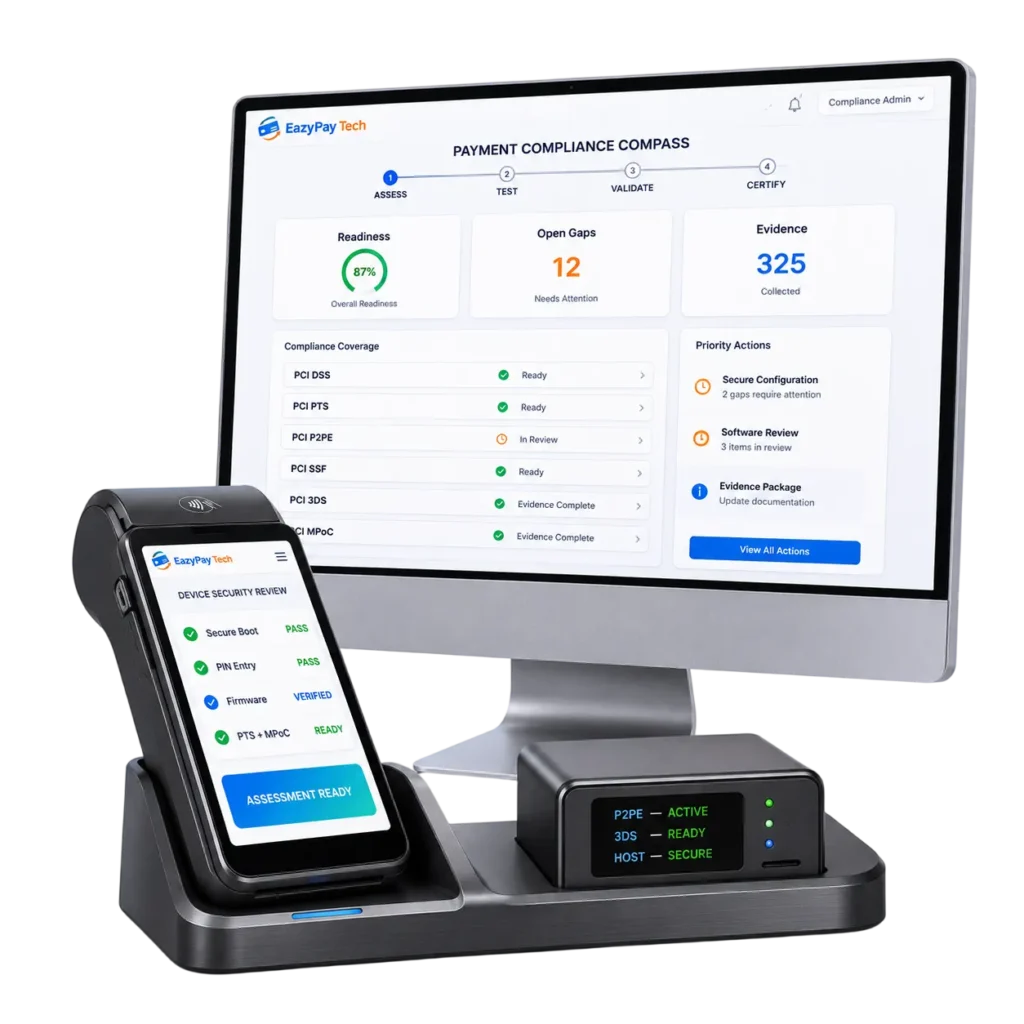
Payment Security
Security support across payment technologies.
PCI Readiness
Readiness for PCI assessment and validation.
Solution Coverage
Coverage across devices, software and systems.
Ongoing Support
Maintain security as PCI requirements evolve.
Choose the Right PCI Standard
PCI DSS
Protects payment account data across secure cardholder environments and connected payment systems.
- Banks & Acquirers
- Merchants
- Payment Processors
- Fintech Companies
- Payment Platforms
PCI PTS
Protects payment devices that securely handle PINs, account data and sensitive payment information.
- PIN Pads
- POS Terminals
- Payment Devices
- Unattended Terminals
- OEM Payment Hardware
PCI P2PE
Protects payment data through encryption from the payment device to a secure decryption environment.
- Encrypted Card-Present Architectures
- Merchant Environments
- POS Deployments
- Payment Providers
PCI Software Security Framework
Supports secure design, development, and lifecycle management for payment software and applications.
- Payment Applications
- POS Software
- Fintech Platforms
- Gateway Applications
- Payment Software Vendors
PCI 3DS
Supports secure 3-D Secure authentication for e-commerce, mobile-commerce, and payment environments.
- 3DS Servers
- Access Control Servers
- Directory Servers
- E-commerce Providers
- Authentication Platforms
PCI MPoC
Supports secure mobile payment acceptance using smartphones, tablets, SoftPOS and Tap on Phone solutions.
- SoftPOS Solutions
- Tap on Phone
- Banks & Acquirers
- Fintech Applications
- Payment Service Providers
PCI DSS READINESS
Protect Your Cardholder Data Environment
PCI DSS provides technical and operational requirements designed to protect payment account data across organizations that store, process, transmit or can impact its security.
The current PCI SSC-supported version is PCI DSS v4.0.1.
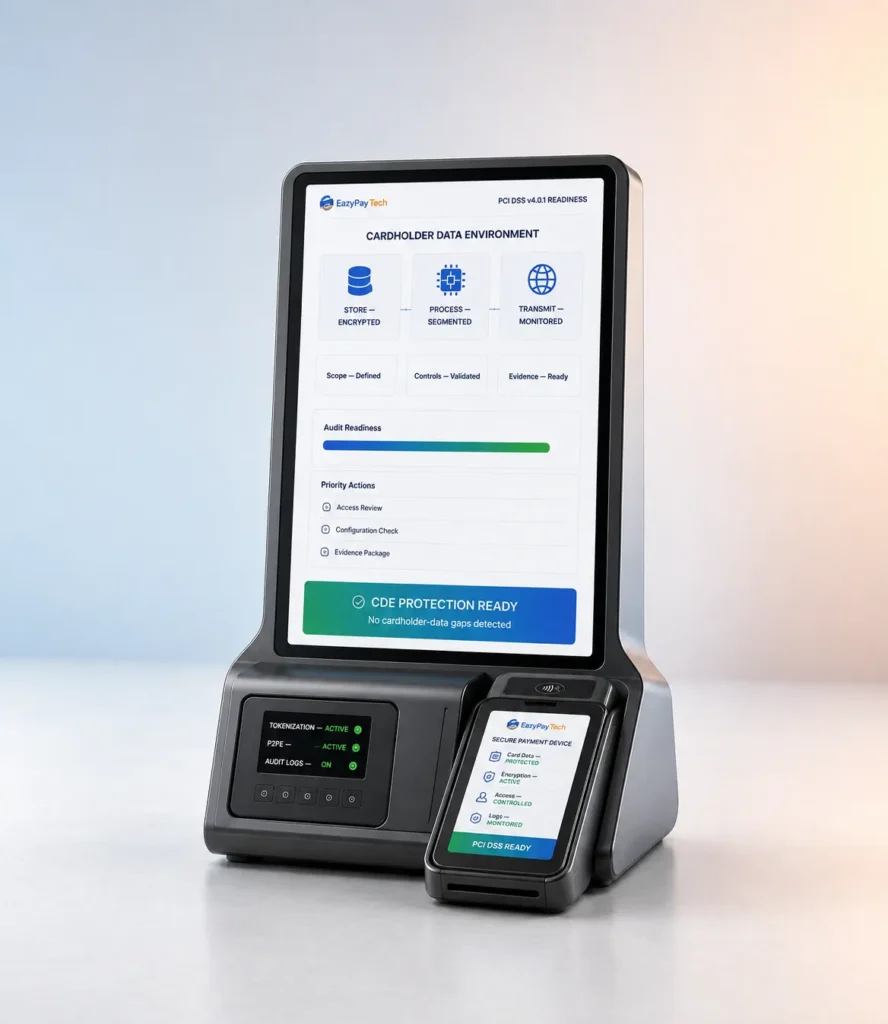
Scope Review
CDE Assessment
Gap Analysis
Audit Readiness
Remediation Plan
ROC / AOC / SAQ
Ongoing Compliance
Need PCI Help?
PCI Support Across the Payment Stack
PCI PTS Compliance
Support payment devices with security, testing and PCI PTS readiness.
- Security Review
- Device Architecture
- PIN & Data Security
- Testing Readiness
- Lab Coordination
- Documentation Support
PCI P2PE Compliance
Support encrypted payment flows with scope, testing and P2PE readiness.
- P2PE Scope Review
- Encryption Boundary
- Architecture Review
- Validation Readiness
- Assessor Coordination
- Requirements Mapping

PCI Compliance Support
From payment devices and software to encryption and SoftPOS security.
PCI PTS • PCI P2PE • PCI SSF • PCI MPoC
PCI Software Security
Support payment software with secure design, lifecycle and SSF readiness.
- Application Scope
- Software Readiness
- Secure SLC Review
- Architecture Review
- Secure Development
- Evidence Preparation
PCI MPoC for SoftPOS
Support SoftPOS solutions with security, testing and MPoC readiness.
- MPoC Assessment
- Solution Architecture
- PIN & Data Security
- Runtime Protection
- Remote Attestation
- Lab Coordination
POS PAYMENT HARDWARE
Flexible POS for Every Environment
Understand Environment
Review your payment setup and data flow.
Define Scope
Identify systems within the PCI scope.
Identify Gaps
Find gaps against PCI requirements.
Plan Remediation
Prioritize fixes for identified gaps.
Implement & Validate
Apply controls and validate readiness.
Prepare Assessment
Organize evidence for assessment.
Resolve Findings
Address testing and assessment findings.
Maintain Compliance
Keep PCI controls updated over time.
WHY EAZYPAY TECH
Payment Expertise Behind PCI Readiness
Hardware + Software Expertise
Experience across POS, payment apps, SoftPOS and backend systems.
PCI + EMV Knowledge
Support where EMV technology and PCI security requirements connect.
Architecture-Focused Approach
Assess how payment data, devices, applications and systems work together.
Remediation Support
Help technical teams understand and resolve identified security findings.
Certification Readiness
Prepare products and environments for assessor or laboratory engagement.
Continuous Support
Support future releases, security updates and reassessment requirements.
Frequently Asked Questions
PCI compliance means meeting applicable payment-security requirements based on how an organization handles payment data, devices, software or payment solutions.
PCI DSS defines security requirements for organizations that store, process, transmit or can impact the security of payment account data.
PCI DSS protects payment data and cardholder environments, while PCI PTS focuses on the security of payment devices handling PINs and sensitive payment data.
PCI P2PE protects payment account data by encrypting it from the payment device through to the secure decryption environment.
PCI Software Security Framework supports secure design, development and lifecycle management of payment software through Secure Software and Secure SLC standards.
PCI MPoC is the primary framework for COTS-based mobile payment acceptance, including SoftPOS and compatible Tap on Phone environments.
No. EazyPay Tech provides PCI readiness, technical consulting, architecture review, testing preparation and compliance support. Formal validation, where required, is performed by the applicable PCI SSC-qualified assessor or recognized laboratory.
EazyPay Tech supports organizations with scope review, gap analysis, architecture assessment, remediation guidance, testing preparation and assessment readiness across applicable PCI requirements.